FTE vs. Hours: How to Choose the Right Unit for Project Planning
When you build a resource plan for a project, one question comes up quickly: do you base it on FTEs or on man hours? Both terms are familiar, but they solve different problems. And it’s not always obvious which one fits the situation in front of you.
If you’re unsure which approach to use, this article breaks the decision down in practical terms. You’ll see what each metric represents, when it’s useful, and how to select the method that gives you the information you need.
What is FTE?
FTE (Full-Time Equivalent) is used in project staffing to express how much capacity a project needs. It’s often used in conjunction with roles. A project might need 0.7 FTE of a Project Engineer and 0.3 FTE of a Mechanical Designer for a given phase. One FTE equals the work of one full-time person. FTE expresses the average capacity a role needs over a period, not the exact timing of when the work happens.
A staffing plan for an IT security project may look like this:
Using FTE has several advantages:
It allows early forecasting: FTE shows whether a project is possible before we do any detailed planning. A project may need 0.2 FTE of a Backend Engineer, but if that person is already at 90% of their capacity (0.9 FTE), the new work can’t start yet. The new project must wait until the engineer is available.
It’s the easiest method for high-level planning. Weekly hour estimates fluctuate too much to be useful early on. A Project Engineer might be needed for 12 hours one week, 24 the next, then 15 after that. All of that averages out to roughly half of a full-time load. Instead of dealing with numbers like 83.5 hours per month, we can express it cleanly as 0.5 FTE.
It shows how many people we need: FTE gives a clear view of the role demand across all projects, which makes it easier to see how one person can support multiple streams of work. If one project needs 0.5 FTE of a QA Engineer and another needs 0.4 FTE, you know a single full-time QA can likely cover both.
Man hours (or person hours) express the total amount of effort required to complete a task or project. One man hour equals one hour of focused work by one person. Unlike FTE, which describes available capacity, man hours describe the workload itself.
Effort estimation in hours gives you a concrete view of what the work demands. A task might require 12 hours, a feature 180 hours, or a full project several thousand hours. These numbers stand on their own, regardless of how many people you have or how they are scheduled.
With that in mind, here’s when hours are the better choice.
Use hours for precise scheduling. Some work relies on one qualified person doing a specific task at a specific time. A technician may need 3 hours to set up a CNC machine on Monday. Work like this depends on fixed durations and fixed timing, so hours are the only unit that shows exactly when the work can happen.
Use hours when people split their time across several projects. Consultants and other shared roles often move between clients or teams from day to day. A consultant might spend Monday with Client A and Tuesday with Client B. In these situations, daily availability matters. Hours make it clear how much time is booked and how much is free, which keeps the schedule realistic.
Use hours when tracking progress. Actuals, burn-downs, and timesheets all run on hours. If a feature was estimated at 40 hours and 18 are done, everyone sees the same status. Hours keep progress tracking straightforward from estimate to delivery.
To be clear, both units have their place. FTE is better for long-range planning, while hours are better for detailed scheduling.
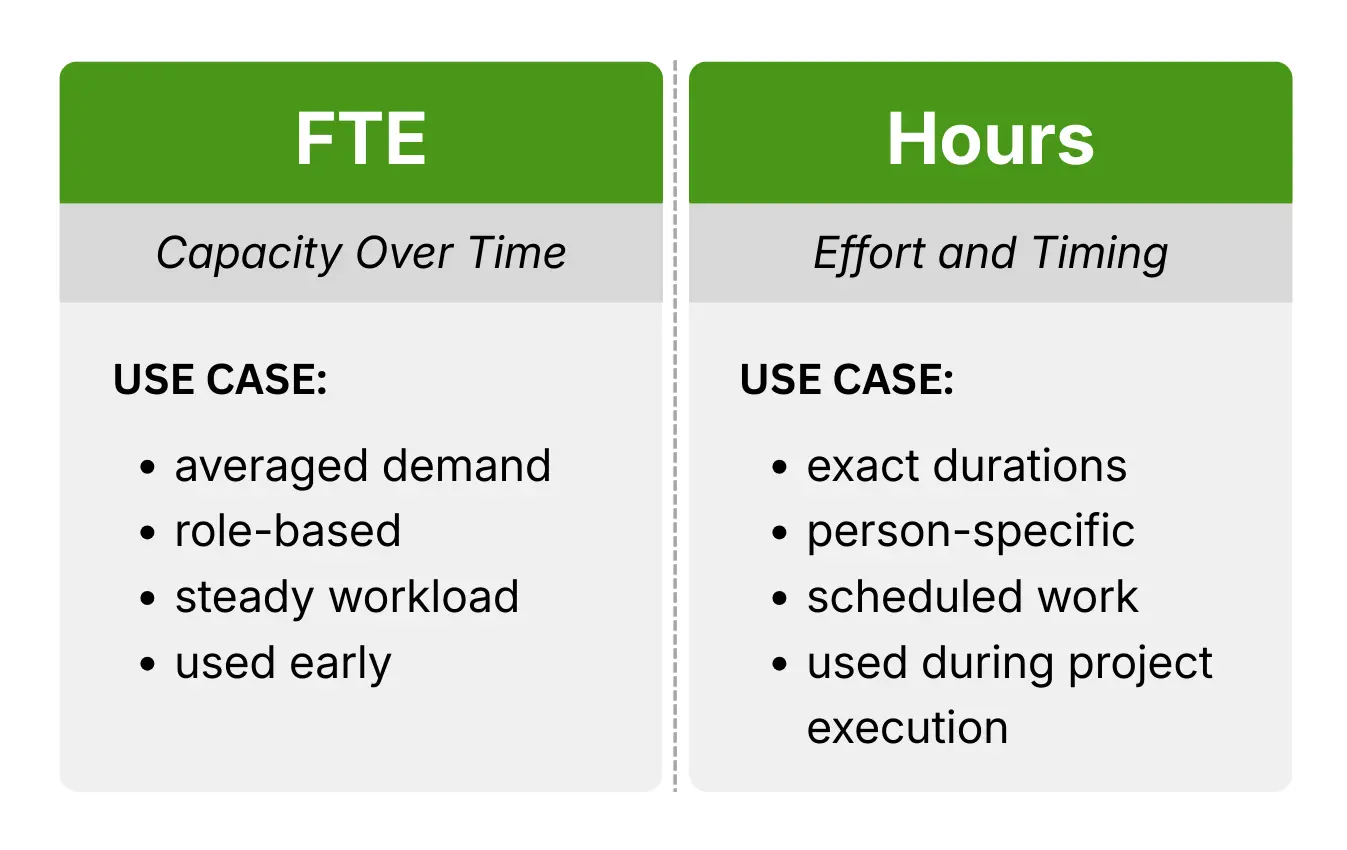
The visual below shows when to use each:
From High-Level To Detailed
Most projects use both methods at different stages. Early in planning, FTE gives a clear view of the roles needed and makes it easy to allocate people before the details are known. Once the project starts, the plan shifts to hours so the specific work can be scheduled and tracked week by week. Most teams use both methods together: FTE to size the work upfront, and hours to manage the details once execution begins.
FAQ
What’s the difference between FTE and hours?
FTE shows the average amount of capacity a project needs from a role over a period of time. Man hours show the exact amount of effort required to do the work. FTE helps with high-level planning; hours help with detailed scheduling and tracking.
How do I convert hours into FTE?
Divide the required hours by the standard weekly hours in your team. Example: If the task takes 20 hours and a full-time week is 40 hours, that’s 0.5 FTE.
When is FTE not useful?
FTE is not useful when the work must be scheduled precisely. If a task needs a specific person for a fixed block of time—like a technician doing a 3-hour job on Monday—FTE can’t show when the work happens. In those cases, hours are the only unit that gives an actionable plan.
How does part-time work factor into FTE?
Part-time hours are turned into FTE by comparing them to a full-time schedule. If someone works half the hours of a full-time person, they count as 0.5 FTE.
Adrian has spent many years managing IT and business projects as a project manager. Today, he teaches project management and develops practical tools for project and resource management.